RAYSONHIGH PERFORMANCE COATINGSMALAYSIA
Rayson StaticGuard · Epoxy

Rayson StaticGuard CX90

Rayson StaticGuard CX90 is a two-component, solvent-free conductive epoxy flooring that gives ESD-protected areas a self-smoothing, permanently conductive, chemically resistant wearing surface.

ConcreteWalls TDS RY-TDS-501
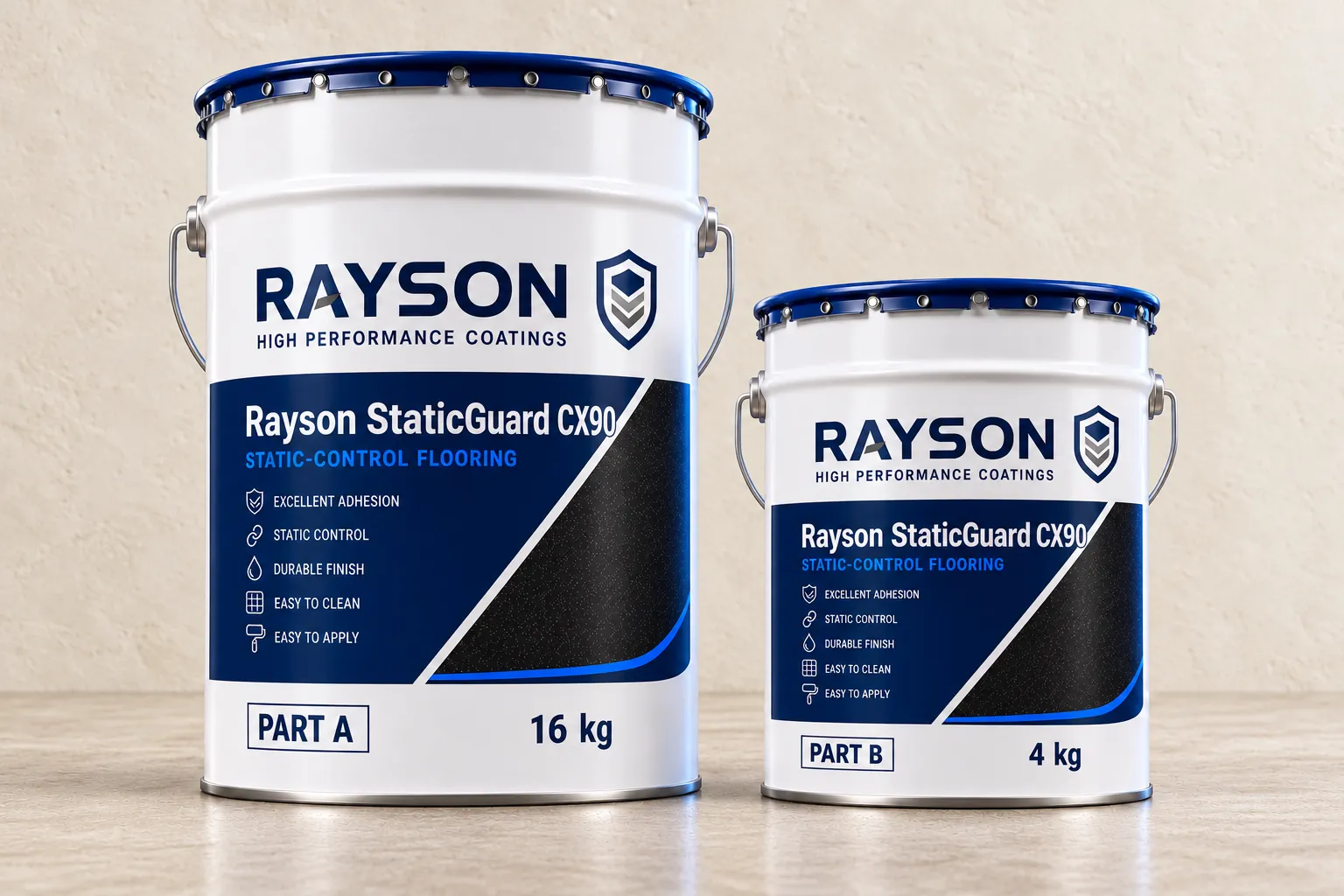
Rayson StaticGuard CX90 pail
Best for

Best for electronics production, data centres and other ESD-protected areas that need a grounded, seamless floor with high mechanical strength.

StaticGuard CX90 is the static-control floor in the Rayson range. The solvent-free, 100%-solids epoxy self-smooths into a seamless surface whose conductivity is built into the cured matrix — not a surface treatment that wears away. Measured electrostatic behaviour falls in the 10⁴–10⁶ ohm range on average, placing floors in conductive ESD territory when installed and earthed correctly.

Mechanically it is a serious floor: tensile and flexural strength up to 40 N/mm² in quartz-filled testing, abrasion loss around 100 mg in standard Taber testing, and excellent impact and chemical resistance. Typical duties include electronics facilities, data centres, antistatic floors and walls, EMI/RFI-shielded rooms, pharmaceutical facilities, aerospace hangars and storage areas.

Film thickness is critical to performance: the system targets 1.0–1.5 mm, and applying in excess of the stated thickness reduces conductivity. Grounding points, earthing layout and post-cure resistance verification should be planned with the facility engineer from day one.

In Malaysia

Supplied by Epovex Coatings Sdn. Bhd., Company No. 202601042128 (1704223-A). The Malaysia launch is scheduled for 1 March 2027; confirm availability and lead time for your project. Installation through an authorised applicator in Johor, Kuala Lumpur or Penang introduced by Rayson, who quotes and warrants the workmanship, or by your own crew with Rayson’s application guidance.

Send an enquiry

Key benefits

  • Permanent conductivity through the coating body (average 10⁴–10⁶ ohms)
  • 100% solids, solvent-free and low VOC
  • Self-smoothing, seamless, easy-to-clean finish
  • High bond strength with excellent impact and chemical resistance

Recommended uses

  • ESD-protected and dissipative-compliant areas
  • Electronics facilities and data centres
  • Antistatic flooring and walls
  • EMI and RFI shielding installations
  • Pharmaceutical facilities and aerospace hangars
  • Warehouses and storage areas requiring static control

Application

  1. Steel trowel
  2. Notched rake
  3. Squeegee and roller
  4. Spike roller immediately after trowelling
SpecificationData sheet value
CoverageMinimum 2.25 kg binder per m² per coat at approximately 1.5 mm (optionally +0.25 kg quartz sand); approximately 5–8 m²/L at 75 µm DFT for thin coats; maximum ~2.5 kg/m² binder plus filler at 1.5 mm
MixingTwo pre-weighed parts, mix ratio 4:1 (A:B) by weight; mix mechanically for at least 2–3 minutes; pot life up to 25 minutes at 28 °C
Drying and curingFull cure approximately 7 days; minimise heavy traffic for 72 hours after application
Pack sizesPart A 16 kg / Part B 4 kg per set

Typical systems

ESD floor system

  1. Mechanically prepare the slab and repair defects with Rayson PatchBond TX80
  2. Prime with Rayson PrimeBond E20 and install earthing points to the agreed layout (system primer selection to be confirmed by the Rayson technical team)
  3. Apply Rayson StaticGuard CX90 at the specified thickness and spike-roll to de-aerate
  4. Verify floor resistance after cure with documented testing

Limitations

  • Applying above the stated film thickness reduces conductivity — thickness control is critical
  • Measured resistance readings are affected by ESD clothing, ambient conditions, measurement equipment, floor cleaning and test personnel
  • Minimum substrate temperature 5 °C; curing between +10 °C and +35 °C; concrete moisture content maximum 5%
  • Requires planned earthing points and post-installation resistance verification

Not suitable for

  • Areas with no earthing provision — conductivity is useless without a ground path
  • Exterior UV-exposed surfaces
  • Thick-build applications beyond the stated film thickness — conductivity drops
  • Substrates with moisture above 5%

Used with

Jobs and industries

Jobs that use Rayson StaticGuard CX90

Rayson-authorised applicators in Johor, Kuala Lumpur and Penang install Rayson StaticGuard CX90 on these jobs and in these industries; its layer is marked in each build-up. Each page shows how the work runs, what to send for a quotation and what decides the price.

By industry, across Malaysia

Industries we cover ↗
01 Rayson system Layers: StaticGuard CX90 conductive epoxy, 1.0–1.5 mm; PrimeBond E20 primer, earthing points to the agreed layout; Concrete slab, prepared and repaired

Data centre floors

ESD floors, plant rooms, loading bays, car parks and roofs for data centres in Johor and across Malaysia.

  1. StaticGuard CX90 conductive epoxy, 1.0–1.5 mm
  2. PrimeBond E20 primer, earthing points to the agreed layout
  3. Concrete slab, prepared and repaired

Plant rooms and loading bays: LevelShield SL120. Car parks: FloorGuard R50 broadcast system. Roofs: SealForce RC40.

Quoted after inspection
02 Rayson system Layers: LevelShield SL120 self-levelling epoxy, coved at the walls; PrimeBond E20 epoxy primer; Concrete slab, prepared and moisture-tested

Pharmaceutical and medical device plant floors

Production rooms, clean rooms, device assembly, washdown rooms and stores in pharmaceutical and medical device plants, with smooth, cleanable floors and walls.

  1. LevelShield SL120 self-levelling epoxy, coved at the walls
  2. PrimeBond E20 epoxy primer
  3. Concrete slab, prepared and moisture-tested

Walls: UraForce WB58. ESD assembly: StaticGuard CX90. Washdown rooms: PurScreed PC70.

Quoted after inspection
03 Rayson system Layers: StaticGuard CX90 conductive epoxy, 1.0–1.5 mm; PrimeBond E20 primer, earthing points to the agreed layout; Concrete slab, prepared and repaired

Electronics and semiconductor plant floors

ESD areas, production halls, wet and chemical rooms, warehouses and car parks in electronics and semiconductor plants, zone by zone.

  1. StaticGuard CX90 conductive epoxy, 1.0–1.5 mm
  2. PrimeBond E20 primer, earthing points to the agreed layout
  3. Concrete slab, prepared and repaired

Outside the ESD programme: LevelShield SL120. Wet and chemical rooms: PurScreed PC70. Car parks: FloorGuard R50 broadcast system.

Quoted after inspection
The practical details

Rayson StaticGuard CX90: questions people ask

Is StaticGuard CX90 conductive or dissipative?

Its average electrostatic behaviour is in the 10⁴–10⁶ ohm range, which sits in conductive ESD territory. The reading achieved on site also depends on installation, earthing, cleaning and how the measurement is taken — always verify against your facility standard.

Why must the film thickness not be exceeded?

Conductivity depends on the conductive network through the coating. Applying thicker than specified increases resistance and can push the floor out of its target range.

How is the floor earthed?

Grounding points are installed as part of the system, connected to the building earth by the electrical contractor. Agree the earthing layout with the facility engineer before installation.

How do we prove the floor meets its ESD target?

With documented resistance testing after full cure, using the measurement method your facility standard specifies. Rayson recommends retesting on a scheduled basis thereafter.

What cleaning products can be used?

Use cleaners that do not leave insulating films — waxes and polymer polishes can raise surface resistance and defeat the static control.

When can production equipment move back in?

Keep heavy traffic off for at least 72 hours and allow around 7 days for full cure before resistance verification. Confirm programme timings with our technical team.

Start a conversation / ↗

Send the job, or ask for materials

Tell us what the surface is, where it is and what it has to withstand. Rayson replies with a system recommendation; for installation, the applicator for your area in Johor, Kuala Lumpur or Penang is introduced to quote the job.

Malaysia launch: 1 March 2027. Enquiries are welcome now; supply, site assessment and installation timing are confirmed for each project.

Thank you. Your enquiry has been received and we reply within one working day, Monday to Friday.

WhatsApp