RAYSONHIGH PERFORMANCE COATINGSMALAYSIA
Floor systems · Johor, KL, Penang · Laid by applicators or sold direct

Self-levelling epoxy flooring in Malaysia, from the maker

Self-levelling epoxy flooring in Malaysia: LevelShield SL120 over PrimeBond E20, laid by Rayson-authorised applicators or sold direct to contractors.

We reply within one working day, Monday to Friday.

Rayson-authorised applicators in Johor, Kuala Lumpur and the Klang Valley, and Penang. Materials and data sheets nationwide.

What is self-levelling epoxy?

Self-levelling epoxy is a two-component, solvent-free resin that is poured over a primed slab, flows out into a seamless, level floor and cures hard. Rayson LevelShield SL120 goes down at about 1.6 to 2.0 kg/m² and takes foot traffic after 18 to 24 hours.

Before you choose

Self-levelling or roller-applied epoxy: which do I need?

Roller-applied FloorGuard R50 seals and colours a sound slab at 0.3 to 0.5 kg/m² a coat, for storage, workshops and garages under normal to medium-heavy wear. Self-levelling LevelShield SL120 goes down at 1.6 to 2.0 kg/m², several times the material, for forklift aisles, loading bays and production floors under mechanical loading, and wherever the floor must be seamless and smooth.

Many floors take both, split by zone: SL120 where wheels turn and loads drop, R50 in the racking zones and store rooms. The survey maps the zones, and the quotation prices each one.

How thick is a self-levelling epoxy floor?

The LevelShield SL120 data sheet gives a consumption, not a thickness: about 1.6 to 2.0 kg/m² as a self-smoothing wearing coat, depending on the filling grade, how porous and how level the slab is, and wastage. The specification sets the build for your traffic.

Self-levelling epoxy follows the slab: it smooths the surface but does not correct falls or deep dips. Where a floor is out of level, or water must run to the drains, the levels are corrected in a screed before the epoxy goes down.

How long before the floor is back in use?

At 30 °C, LevelShield SL120 takes foot traffic after about 18 hours and light traffic after 2 days, with full cure in 5 days; at 20 °C it needs 24 hours, 4 days and 7 days. It is solvent-free, with no solvent odour, so it can be laid in enclosed rooms.

The work is planned in sections around those times, so production or dispatch keeps running in the other zones. Forklifts and heavy loads return when the specification allows.

Is self-levelling epoxy the same as resin flooring?

Resin flooring is the family, and self-levelling epoxy is one member. The family runs from roller-applied epoxy coatings through self-levelling epoxy to polyurethane-cement screeds, each cured on the slab from a liquid resin.

Where hot washdown, steam or heavy chemical spillage set the brief, the resin floor to specify is PU-cement instead. Rayson makes all three, so the specification follows what the floor has to do.

Can self-levelling epoxy go outdoors or in the sun?

No. Like every epoxy, LevelShield SL120 is not colour-stable in sunlight: its data sheet rules out exterior UV exposure, so it is an interior floor. Indoors it needs a slab at 5 °C or warmer and cures between 10 °C and 35 °C.

Showrooms with strong daylight through glass usually take a coloured epoxy body coat under a UV-stable polyurethane topcoat instead, as the PU flooring page explains. Open porches and decks take another system: send a photo and Rayson tells you which.
Self-levelling epoxy against the other resin floors

Self-levelling epoxy against the other resin floors
Compared onLevelShield SL120 self-levelling epoxyFloorGuard R50 roller-applied epoxyPurScreed PC70 PU-cement screed
How it goes onPoured, spread with a notched trowel or rake, spike-rolledRolled on in two coatsTrowelled on as a self-smoothing screed
MaterialAbout 1.6 to 2.0 kg/m²0.3 to 0.5 kg/m² a coat1.5 to 3 mm, about 1.8 kg/m² per mm
PrimerPrimeBond E20PrimeBond E20None separate: laid on prepared concrete
SuitsForklift aisles, loading bays, production halls, clean roomsStorage, workshops and garages under normal to medium-heavy wearHot washdown, steam, chemical spillage, heavy traffic
Full cure5 days at 30 °C, 7 days at 20 °C7 days7 days

A first guide from the data sheets. The specification confirms the system for your traffic, loads and chemicals.

Where it suits

The floors it suits

  • Forklift aisles, loading bays and staging areas
  • Production, assembly and packing halls
  • Pharmaceutical areas and clean rooms, which its data sheet lists
  • Plant rooms, maintenance workshops and garages
  • A floor that must be seamless and smooth, not just sealed
Where it goes wrong

Why these floors fail

  • Poured on a slab that was not ground, so it lifts
  • Laid on concrete younger than 28 days or wetter than 5%, so it blisters
  • Mixed by eye, or poured too late: SL120 must be laid within about 20 minutes at 28 °C
  • Left without spike-rolling, so trapped air leaves pinholes
  • Laid where hot washdown calls for a PU-cement screed
How the floor is laid

From the bare slab to a floor in service

  1. Survey the slab and the traffic

    Moisture and bond tests, a joint and crack map, and what runs and drops on the floor. The concrete must be at least 28 days old, with moisture below 5%.

  2. Grind and repair

    Diamond grinding or shot blasting to sound concrete, at least 1.5 N/mm² in a pull-off test; cracks, holes and joints repaired, and the dust vacuumed off.

  3. Prime with PrimeBond E20

    Parts A and B mixed 2:1 by weight and rolled at 6 to 8 m² per kg, to anchor the floor and close the pores that would otherwise leave pinholes.

  4. Pour LevelShield SL120

    Mixed 4:1 by weight for 2 to 3 minutes, poured and spread at about 1.6 to 2.0 kg/m², spike-rolled to release the air, and laid in sections within its 20-minute pot life; cured between 10 °C and 35 °C.

What to send

Three details are enough for a system recommendation

  1. The floor, wide, and its worst patch, close
  2. The area in sq ft or m², what runs and drops on it, and any chemicals
  3. When sections can close, and the town the site is in

Send them on WhatsApp

What it costs

What does self-levelling epoxy flooring cost in Malaysia?

Laid by a Rayson-authorised applicator, it is quoted per square foot after a slab survey. Five things decide it: the area, the state of the slab (grinding, cracks, joints and moisture), the build for the traffic, how the work is sectioned around your operation, and access and working hours. Material ordered direct is quoted per order, by the 20 kg set. Rayson publishes no price list.

Who stands behind the job

  • Rayson makes the materials, writes the specification and warrants the material. It supplies them direct in Malaysia through Epovex Coatings Sdn. Bhd., with the data sheets; supply and delivery are confirmed for each order.
  • The Rayson-authorised applicator for your area an independent company authorised by Rayson, contracts with you, inspects, quotes, lays the floor and warrants the workmanship. Or your own flooring contractor orders the material and lays it to the data sheet.
  • Rayson is not the installer and is not a party to the installation contract. Two warranties, two companies.
Where we work

Self-levelling epoxy flooring in Johor, Kuala Lumpur and Penang

  • Johor Bahru
  • Iskandar Puteri
  • Pasir Gudang
  • Senai
  • Kulai
  • Kuala Lumpur
  • Petaling Jaya
  • Shah Alam
  • Subang Jaya
  • Penang

Independent, Rayson-authorised applicators in Johor, Kuala Lumpur and the Klang Valley, and Penang. Sites elsewhere are confirmed per enquiry; materials and data sheets are supplied nationwide.

Rayson materials on this job

Every layer has a published data sheet

Layers, top to bottom: LevelShield SL120 self-levelling epoxy, about 1.6–2.0 kg/m²; PrimeBond E20 primer, 6 to 8 m² per kg; Concrete at least 28 days old, ground, cracks and joints repaired

The build-up, top to bottom · diagram, not to scale

  1. LevelShield SL120 self-levelling epoxy, about 1.6–2.0 kg/m²
  2. PrimeBond E20 primer, 6 to 8 m² per kg
  3. Concrete at least 28 days old, ground, cracks and joints repaired

Racking zones and store rooms: FloorGuard R50 roller coats over PrimeBond E20. Hot washdown and chemical spillage: PurScreed PC70.

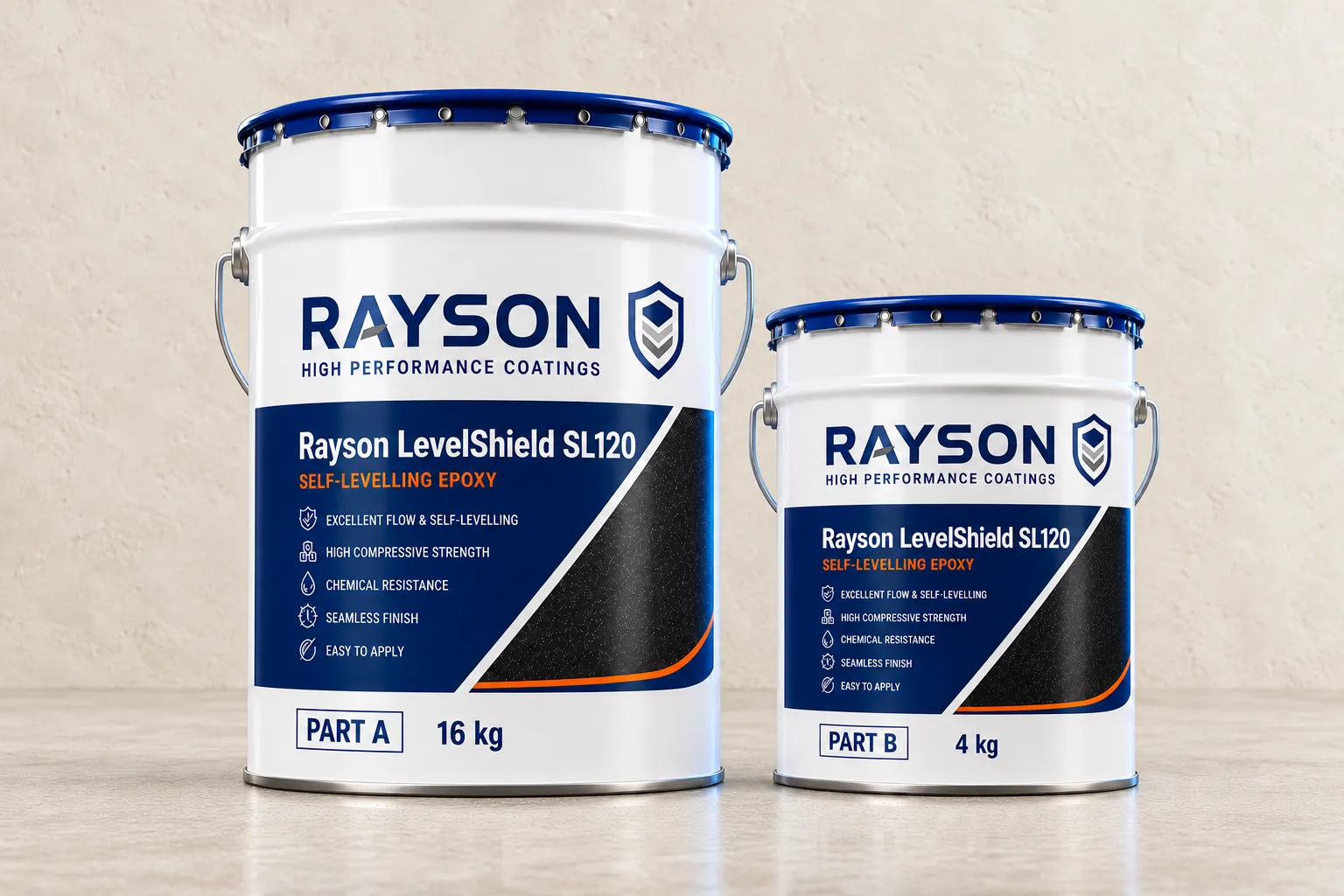
Rayson LevelShield SL120 pail

Rayson LevelShield SL120

Rayson LevelShield SL120 is a solvent-free, two-component, self-smoothing epoxy floor system that delivers a seamless wearing surface with medium to heavy chemical resistance and high mechanical strength.

Specifications →
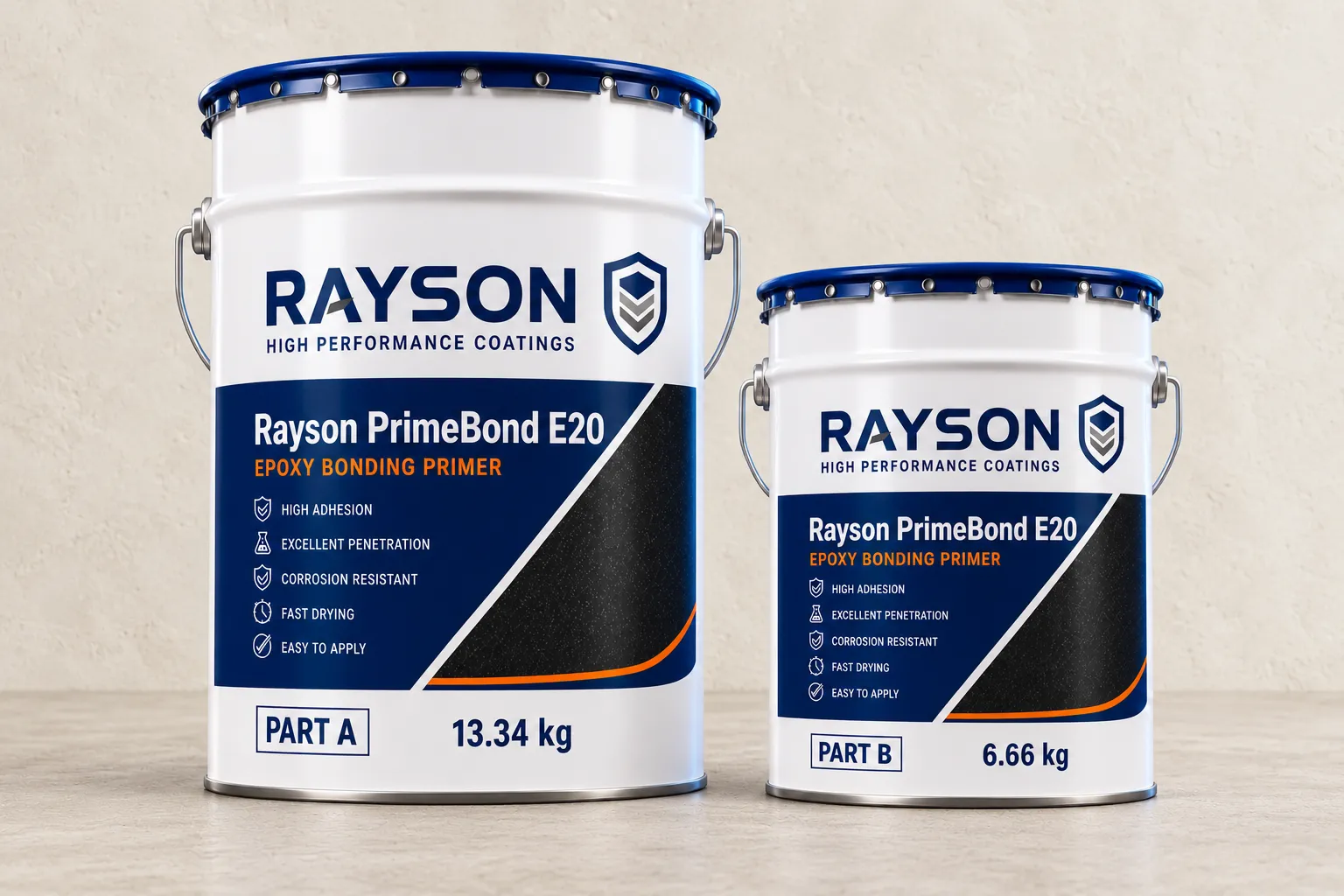
Rayson PrimeBond E20 pail

Rayson PrimeBond E20

Rayson PrimeBond E20 is a two-component, medium-viscosity, solvent-free epoxy bonding primer that anchors resin floor systems to concrete, screed, asphalt and prepared metal — on dry or damp substrates.

Specifications →
The Rayson difference

An installer buys whatever is on the shelf. A Rayson-authorised applicator installs what Rayson makes.

01

The maker writes the specification

The system is specified by the company that makes the material, and installed by an independent applicator Rayson has authorised, not chosen from whatever a supplier had on the shelf that week.

02

A data sheet for every layer

Every Rayson material on your floor or roof has a published technical data sheet. You can read what went in, and so can your consultant.

03

Two warranties, two companies

Rayson warrants the material as its maker. The authorised applicator, an independent company that contracts with you, warrants the workmanship. Each warranty is issued by the company responsible for it.

04

Same materials on both sides of the Causeway

The products, data sheets and application methods are the ones Rayson publishes in Singapore. Nothing is rebadged for Malaysia.

05

Materials direct, for your own crew

Contractors and facility teams buy the same materials direct from the maker, with application guidance. The applicator is there when you want the job done for you.

Related jobs

Where it is laid, and the alternative

Each with the Rayson layers it uses

All floor systems ↗
01 Rayson system Layers: PurScreed PC70 PU-cement screed, 1.5–3 mm; Concrete slab, prepared, coves and drains detailed

PU flooring

PurScreed PC70 PU-cement screed for hot, wet and chemical floors, and UraForce WB58 topcoat for colour that lasts in daylight; laid or sold direct.

  1. PurScreed PC70 PU-cement screed, 1.5–3 mm
  2. Concrete slab, prepared, coves and drains detailed

Colour that must not yellow in daylight: FloorGuard R50 over PrimeBond E20, under at least two coats of UraForce WB58.

Quoted after inspection
02 Rayson system Layers: LevelShield SL120 self-levelling epoxy; PrimeBond E20 epoxy primer; Concrete slab, ground, joints and cracks repaired

Warehouse and logistics floors

Forklift aisles, racking zones and loading bays in warehouses and distribution centres, in self-levelling or roller-applied epoxy.

  1. LevelShield SL120 self-levelling epoxy
  2. PrimeBond E20 epoxy primer
  3. Concrete slab, ground, joints and cracks repaired

Racking and storage zones: FloorGuard R50 roller coats. Heavy traffic with spillage: PurScreed PC70.

Quoted after inspection
03 Rayson system Layers: LevelShield SL120 self-levelling epoxy, coved at the walls; PrimeBond E20 epoxy primer; Concrete slab, prepared and moisture-tested

Pharmaceutical and medical device plant floors

Production rooms, clean rooms, device assembly, washdown rooms and stores in pharmaceutical and medical device plants, with smooth, cleanable floors and walls.

  1. LevelShield SL120 self-levelling epoxy, coved at the walls
  2. PrimeBond E20 epoxy primer
  3. Concrete slab, prepared and moisture-tested

Walls: UraForce WB58. ESD assembly: StaticGuard CX90. Washdown rooms: PurScreed PC70.

Quoted after inspection
The practical details

Questions people ask

Can our own contractor lay LevelShield SL120?

Yes. Rayson sells SL120 and PrimeBond E20 direct through Rayson Malaysia (Epovex Coatings Sdn. Bhd.), with the data sheets and application guidance; supply and delivery are confirmed for each order. It is a trade job: the crew grinds the slab, mixes by weight and lays against a 20-minute pot life.

How much material do I need?

At about 1.6 to 2.0 kg/m², one 20 kg set of SL120 covers roughly 10 to 12.5 m² (about 108 to 135 sq ft), and PrimeBond E20 primes 6 to 8 m² per kg. Give the area and the state of the slab, and Rayson works out the sets.

Does it need a primer?

Yes: PrimeBond E20 on mechanically prepared concrete. It anchors the floor and closes the pores that would otherwise leave pinholes, and it accepts a damp but not wet slab, up to 5% moisture.

Is a self-levelling floor slippery?

Its surface is smooth and easy to clean, but it can be slippery when wet or oily. Ramps, wash areas and wet process zones take a textured, aggregate-broadcast finish instead, and the specification marks those zones.

Who gives the warranty?

Rayson warrants the material as its maker when it is laid to the data sheet; the Rayson-authorised applicator warrants its workmanship, and both are written into the quotation. A floor laid by your own contractor carries that contractor’s workmanship terms.

Start a conversation / ↗

Send the job, or ask for materials

Tell us what the surface is, where it is and what it has to withstand. Rayson replies with a system recommendation; for installation, the applicator for your area in Johor, Kuala Lumpur or Penang is introduced to quote the job.

Malaysia launch: 1 March 2027. Enquiries are welcome now; supply, site assessment and installation timing are confirmed for each project.

Thank you. Your enquiry has been received and we reply within one working day, Monday to Friday.

WhatsApp
WhatsApp three photos