RAYSONHIGH PERFORMANCE COATINGSMALAYSIA
Waterproofing systems · Johor, KL, Penang · Applied by applicators or sold direct

Concrete and cementitious waterproofing in Malaysia: waterproof cement, and where a membrane takes over

Cementitious waterproofing in Malaysia: SealForce RW1 waterproof cement for slurry, render and screed, WB20 where cracks move, sprayed polyurea for basements.

We reply within one working day, Monday to Friday.

Rayson-authorised applicators in Johor, Kuala Lumpur and the Klang Valley, and Penang. Materials and data sheets nationwide.

What is cementitious waterproofing?

Cementitious waterproofing is a cement-based layer, a slurry coat, render or screed, mixed with a waterproofing additive so the layer itself resists water. Rayson SealForce RW1 is that additive; it does not bridge cracks that move, so under tiles in toilets and balconies the membrane is SealForce WB20.

Before you choose

Waterproof cement, a slurry coat or a membrane: which does my job need?

A wall, floor or render that has to shed water and stay sound takes cement with SealForce RW1: a slurry coat of 1 part RW1, 1 part cement and 1 part sand, or RW1 diluted 1:1 in place of the mixing water of a render or screed. A surface that will crack or move, a toilet floor, a shower wall, a balcony under tiles, takes SealForce WB20, which bridges cracks over 2 mm, with RW1 in the screed and tile bed around it.

The two are used together more often than apart: WB20 is the membrane, RW1 makes every cement layer above and below it denser and better bonded. The survey decides which layers each room needs.
Is cementitious waterproofing better than bitumen?

For the cement layers of toilets, bathrooms, kitchens, balconies and walls, a cementitious system with a liquid membrane is the simpler job: no torch, no sheet laps to seal, no solvent odour, and the tiles go onto the screed above it. Bituminous membranes are sheets laid with a torch, lapped at every joint, that need a protective layer over them; they belong on the roofs and buried structures they were made for, which is not Rayson’s range.

Where a job genuinely needs a sheet, Rayson says so. Where it needs a seamless membrane that can be walked on and left exposed, the SealForce polyureas and the AC10 acrylic do that without sheets or torches.

Can cement waterproofing fix a leaking basement or water tank?

No. The RW1 data sheet rules out basements against groundwater, water-retaining structures and permanent immersion, and WB20 is a positive-side membrane that must not be used where water pushes from behind. Those structures take a sprayed pure polyurea, SealForce SP200 for below-grade tanking and waste water, SP210 for drinking water, applied by a specialist spray applicator.

The polyurea waterproofing page sets out the four polyureas. A slurry coat with RW1 still has a place on a basement wall above the water line, as the cement layer the finish bonds to.

Does it stop rising damp in a wall?

A render with RW1, or a slurry coat on blockwork, cuts the water that rain and splash drive through a wall, and it bonds a new render to old concrete. Damp rising from the ground into the foot of a wall is a different problem: it needs a damp-proof course or an injected barrier, which Rayson does not make, and a dense render on its own can push the damp higher.

The applicator traces where the moisture comes from first. Rain through the outside face takes an RW1 render under SealForce AC10; a wet room behind the wall takes WB20 in that room; rising damp is referred to a damp-proofing contractor before any render goes on.

Cement waterproofing, membrane and bitumen, compared

Cement waterproofing, membrane and bitumen, compared
Compared onSealForce RW1 in the cementSealForce WB20 membraneBituminous sheet membraneSprayed polyurea, SealForce SP200
What it isA latex additive mixed into slurry coats, renders, screeds, tile beds and groutA one-part, water-based liquid membrane, rolled on in two coatsSheets laid with a torch, lapped at every jointA hot-sprayed, seamless lining
Where it goesWalls, floors and renders that must shed water; bonding new work to oldUnder tiles in toilets, bathrooms, kitchens and balconiesRoofs and buried structures, by their own tradesBasements, tanks and containment, below grade
Cracks that moveNot bridgedBridged, over 2 mmDepends on the sheet and its lapsElongation and strength for structures under load
Water from behindNoNo: positive side onlyOnly as part of a tanking designYes, in a tanking system
Joints and odourNone: mixed into the layer; no odourSeamless; no solvent odourLapped joints; torch and fumesSeamless; sprayed by a specialist
Tiles afterTiles bed straight onto the RW1 screedAfter the 24-hour ponding test, through a screed or tile bedOver a screed that protects the sheetNot usually tiled

From the data sheets, and the general character of bituminous sheet systems, which Rayson does not make. The survey confirms the layers for your job.

Where it suits

Where it is used

  • A render or screed that has to be water-resistant: wet rooms, yards, external walls
  • Tiles to be laid over old concrete or old tiles, with a bond that lasts
  • A toilet, kitchen or balcony being re-waterproofed before tiling
  • Grout that stains and lets water through
  • A specification that calls for cementitious waterproofing or a waterproof cement slurry
  • A basement or tank, which this page sends to polyurea instead
Where it goes wrong

Why these jobs fail

  • Plain cement render or screed asked to be the only waterproofing
  • RW1 used as the only membrane under toilet tiles, where WB20 is needed
  • A slurry coat left to dry before the render or tiles went on, so nothing bonded
  • Extra water in the mix, which weakens the mortar
  • Cement waterproofing used against groundwater, where it cannot hold
How the membrane goes on

From the bare surface to a watertight finish

  1. Survey and trace

    Where the water comes from, which cement layers the room needs, whether anything moves or cracks, and whether water pushes from behind. Concrete must be at least 28 days old, render at least 7.

  2. Prepare and repair

    Old surfaces cleaned and roughened, paint scabbled to expose at least 80% of the substrate, loose material removed; cracks, voids and joints filled with PatchBond TX80, which bonds to mat-damp concrete.

  3. Slurry, membrane, render or screed

    A slurry coat of 1 part RW1, 1 part cement and 1 part sand on the prepared surface; SealForce WB20 in two coats where the room needs a membrane, ponding-tested after 24 hours; then the render or screed with RW1 diluted 1:1 in place of the mixing water, placed while the slurry is still wet.

  4. Tile, grout, protect

    Tiles bedded in adhesive or thin-set mortar with RW1, grouted after 24 hours with RW1 in the grout; fresh work kept from rain, sun and drying wind; the area in use 24 hours after grouting.

What to send

Three details are enough for a system recommendation

  1. The surface, wide: wall, floor, toilet or balcony
  2. Where the water shows, or the worst patch, close
  3. The area in m² or sq ft, what the surface will carry, and the town

Send them on WhatsApp

What it costs

What does cementitious waterproofing cost in Malaysia?

Applied by a Rayson-authorised applicator, it is quoted per square foot after inspection, as part of the render, screed or tiling it goes into. Five things decide it: the area, what comes up and how much preparation the old surface needs, whether the room also needs a WB20 membrane, the tiling and grouting above, and access. RW1 is the economical part of a wet-area job; the membrane and the tiling are the larger ones. Material ordered direct is quoted per order, by the 20 kg pail. Rayson publishes no price list.

Who stands behind the job

  • Rayson makes the materials, writes the specification and warrants the material. It supplies them direct in Malaysia through Epovex Coatings Sdn. Bhd., with the data sheets; supply and delivery are confirmed for each order.
  • The Rayson-authorised applicator for your area an independent company authorised by Rayson, contracts with you, inspects, quotes, applies the rolled membranes and warrants the workmanship; sprayed linings are applied by a specialist spray applicator. Or your own contractor orders the material and applies it to the data sheet.
  • Rayson is not the installer and is not a party to the installation contract. Two warranties, two companies.
Where we work

Cementitious waterproofing in Johor, Kuala Lumpur and Penang

  • Johor Bahru
  • Iskandar Puteri
  • Pasir Gudang
  • Senai
  • Kulai
  • Kuala Lumpur
  • Petaling Jaya
  • Shah Alam
  • Subang Jaya
  • Penang

Independent, Rayson-authorised applicators in Johor, Kuala Lumpur and the Klang Valley, and Penang. Sites elsewhere are confirmed per enquiry; materials and data sheets are supplied nationwide.

Rayson materials on this job

Every layer has a published data sheet

Layers, top to bottom: Tiles, bedded and grouted with SealForce RW1; Screed with RW1 in place of the mixing water; SealForce WB20, two coats, where the room needs a membrane; Concrete or render, cleaned, roughened and repaired

The build-up, top to bottom · diagram, not to scale

  1. Tiles, bedded and grouted with SealForce RW1
  2. Screed with RW1 in place of the mixing water
  3. SealForce WB20, two coats, where the room needs a membrane
  4. Concrete or render, cleaned, roughened and repaired

Walls and floors with no membrane: a slurry coat of RW1, cement and sand on the old concrete, then the render or screed with RW1. Basements and tanks: SealForce SP200, sprayed.

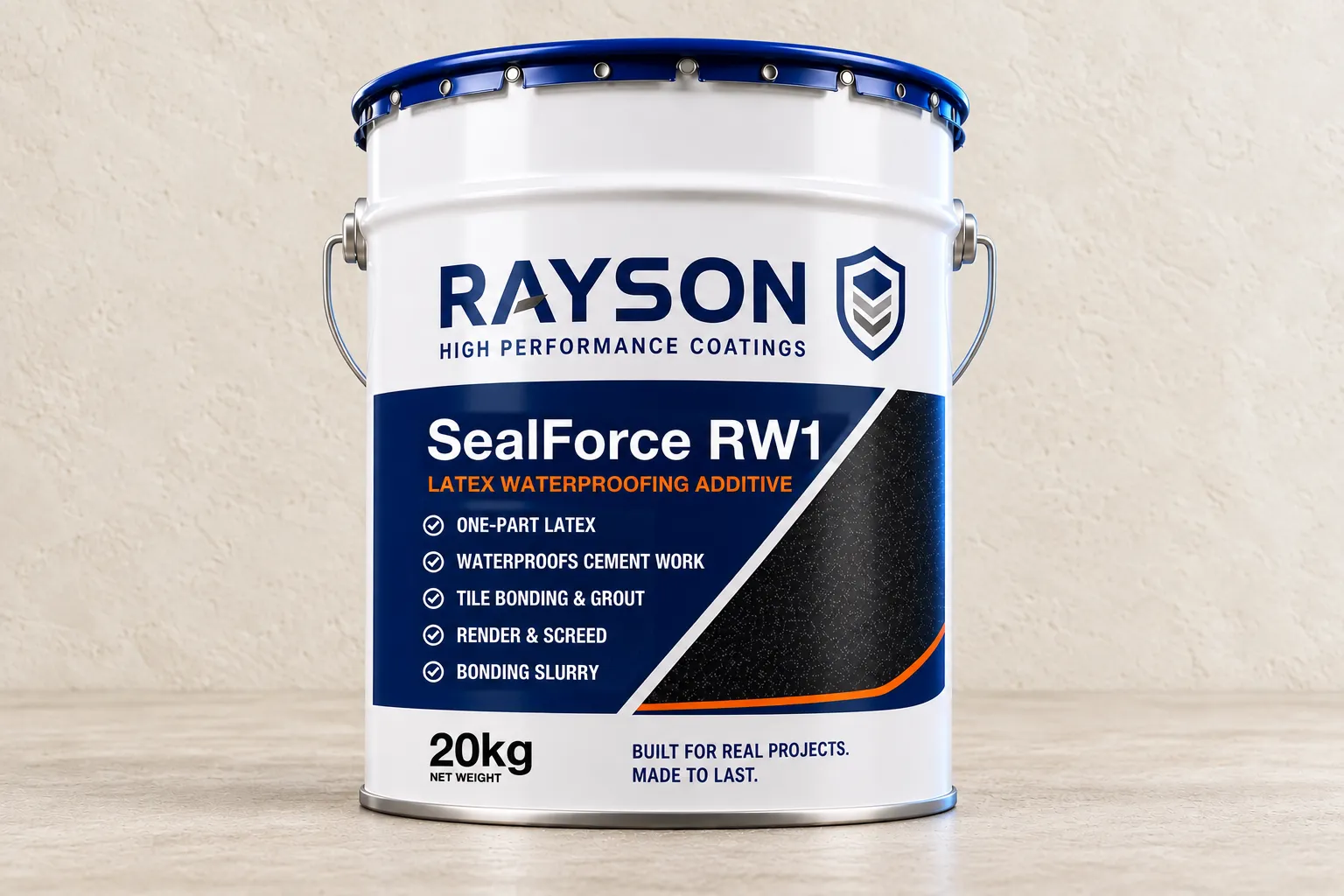
Rayson SealForce RW1 pail

Rayson SealForce RW1

Rayson SealForce RW1 is a one-part latex waterproofing and bonding additive for cement-based work — mixed into renders, screeds, slurry coats, tile adhesives and grout to cut water penetration, strengthen the mortar and improve its bond and flexibility.

Specifications →
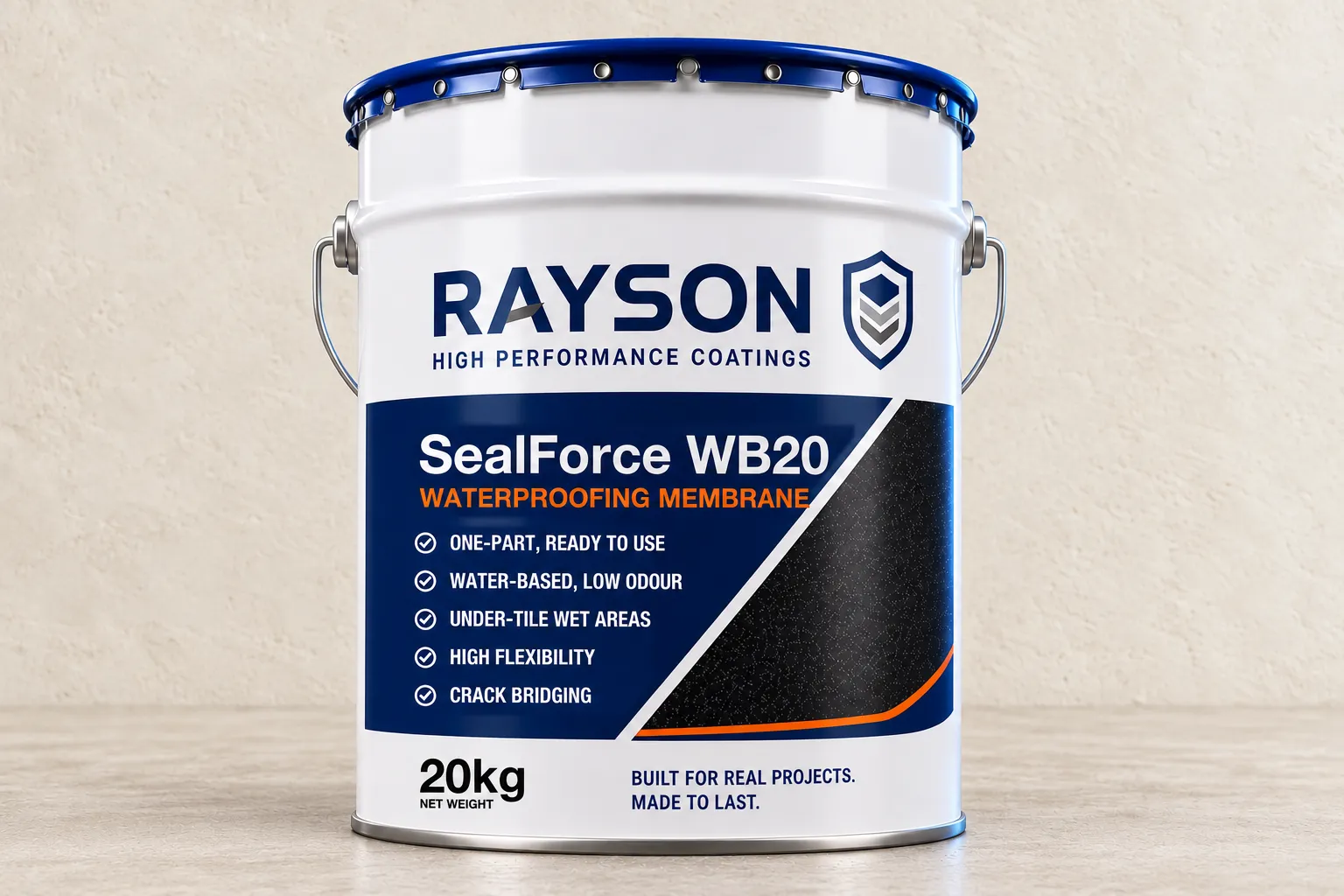
Rayson SealForce WB20 pail

Rayson SealForce WB20

Rayson SealForce WB20 is a one-part, water-based, polyurethane-modified waterproofing membrane for toilets, showers, bathrooms, balconies and other interior wet areas — rolled or brushed on in two coats and concealed beneath the tiles, screed or render.

Specifications →
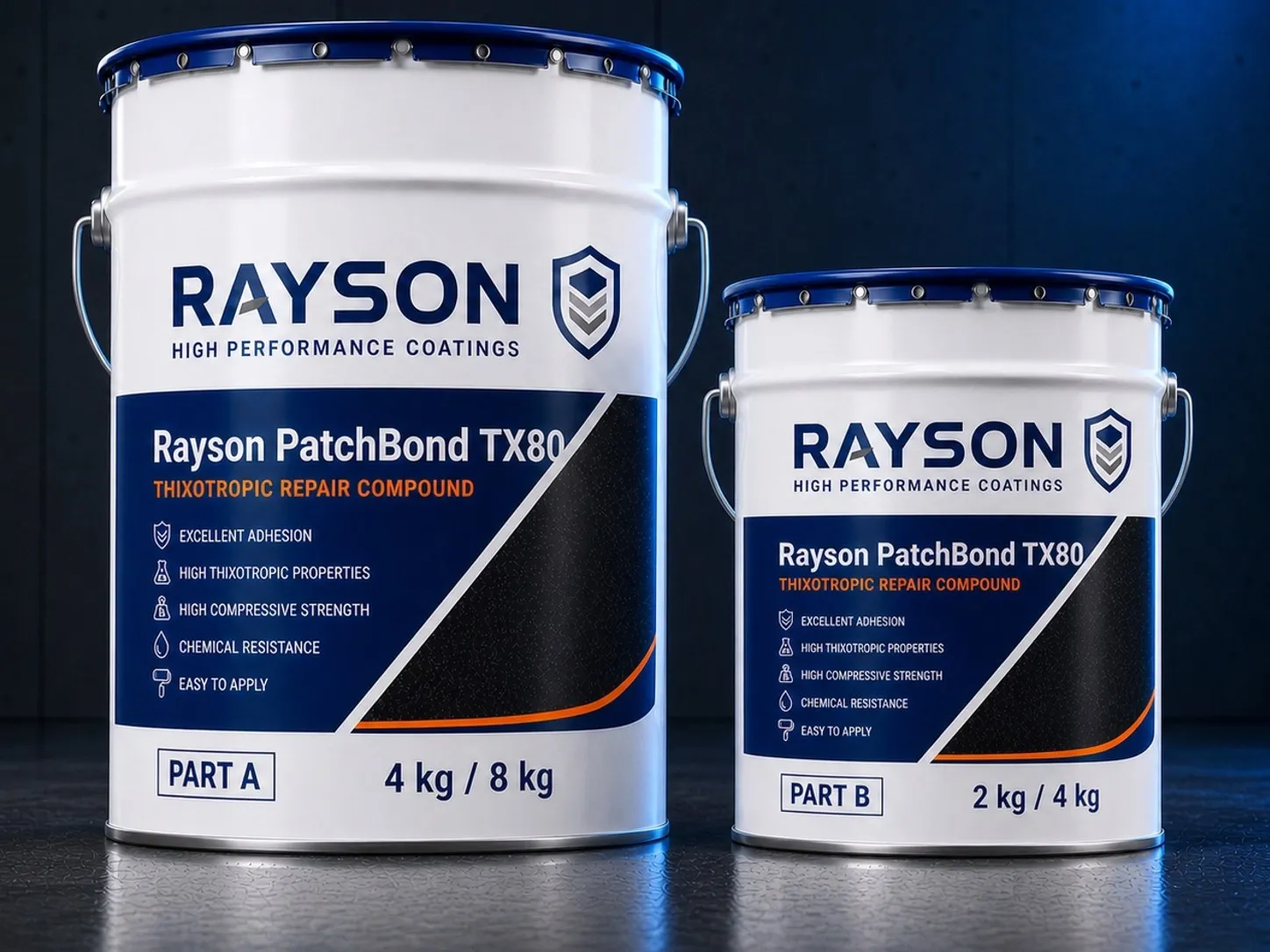
Rayson PatchBond TX80 pail

Rayson PatchBond TX80

Rayson PatchBond TX80 is a two-component, solvent-free thixotropic epoxy adhesive and repair compound with exceptional sag resistance that bonds and fills on vertical, overhead and even mat-damp concrete surfaces.

Specifications →
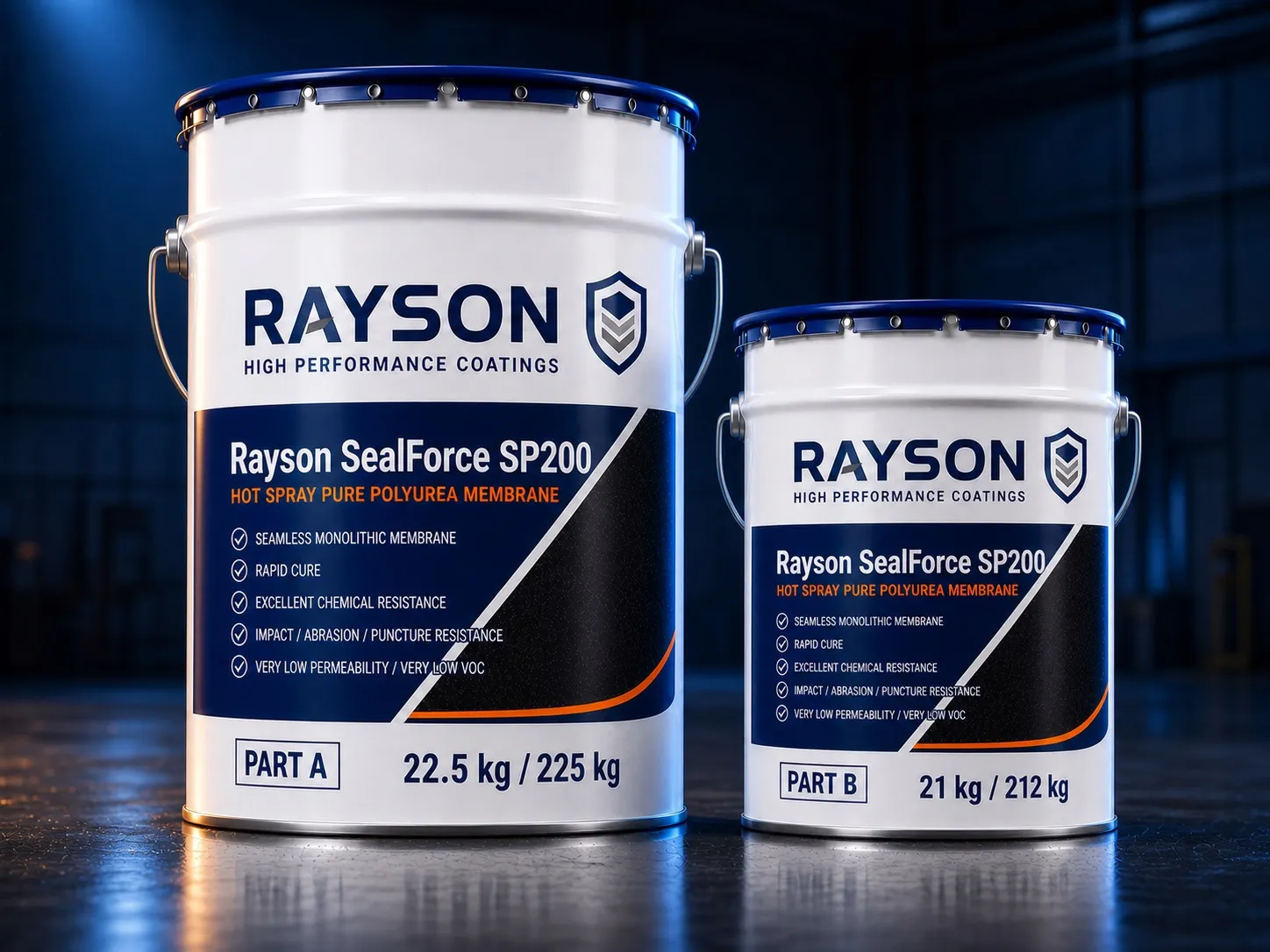
Rayson SealForce SP200 pail

Rayson SealForce SP200

Rayson SealForce SP200 is a hot spray-applied, 100% solids, rapid-curing pure polyurea membrane that forms a seamless, chemically resistant waterproof and protective lining on concrete and steel.

Specifications →
The Rayson difference

An installer buys whatever is on the shelf. A Rayson-authorised applicator installs what Rayson makes.

01

The maker writes the specification

The system is specified by the company that makes the material, and installed by an independent applicator Rayson has authorised, not chosen from whatever a supplier had on the shelf that week.

02

A data sheet for every layer

Every Rayson material on your floor or roof has a published technical data sheet. You can read what went in, and so can your consultant.

03

Two warranties, two companies

Rayson warrants the material as its maker. The authorised applicator, an independent company that contracts with you, warrants the workmanship. Each warranty is issued by the company responsible for it.

04

Same materials on both sides of the Causeway

The products, data sheets and application methods are the ones Rayson publishes in Singapore. Nothing is rebadged for Malaysia.

05

Materials direct, for your own crew

Contractors and facility teams buy the same materials direct from the maker, with application guidance. The applicator is there when you want the job done for you.

Related jobs

Where cement waterproofing is used, and where a membrane takes over

Each with the Rayson layers it uses

Waterproofing in Malaysia ↗
01 Rayson system Layers: Tiles, laid after the 24-hour flood test; Tile bed with SealForce RW1; SealForce WB20, two coats, turned up the walls; Screed with SealForce RW1; Floor slab

Toilet and bathroom waterproofing

The membrane under the tiles, done once and flood-tested before the tiler starts.

  1. Tiles, laid after the 24-hour flood test
  2. Tile bed with SealForce RW1
  3. SealForce WB20, two coats, turned up the walls
  4. Screed with SealForce RW1
  5. Floor slab
Quoted after inspection
02 Rayson system Layers: SealForce AC10 on the external face; SealForce AP05 primer; Render with SealForce RW1, cracks filled; Brick or block wall

Wall seepage and crack repair

Damp, peeling, mouldy walls: rain through the render, rising damp or a leak next door.

  1. SealForce AC10 on the external face
  2. SealForce AP05 primer
  3. Render with SealForce RW1, cracks filled
  4. Brick or block wall

Water from a wet area behind the wall: that room is re-waterproofed instead.

Quoted after inspection
03 Rayson system Layers: SealForce RC40 polyurea, two layers, UV-stable and walkable; The primer its data sheet names for the surface; Roof or deck slab, cracks repaired, details reinforced

Polyurea waterproofing

SealForce polyureas: RC40 and RC30 rolled on for roofs, decks and planters, SP200 and the potable-grade SP210 hot-sprayed for tanks, containment and large roofs.

  1. SealForce RC40 polyurea, two layers, UV-stable and walkable
  2. The primer its data sheet names for the surface
  3. Roof or deck slab, cracks repaired, details reinforced

Decks, planters and car park decks: SealForce RC30, rolled on. Tanks, containment and large roofs: SealForce SP200, or the potable-grade SP210, hot-sprayed.

Quoted after inspection
04 Rayson system Layers: SealForce AC10, two coats, fleece at moving cracks; SealForce AP05 primer; Roof, render or old roof tiles, sound and dry

Waterproof coating

SealForce AC10 acrylic, RC40 and RC30 polyurea and the WB20 wet-area membrane, sold direct with the coverage and a step-by-step guide.

  1. SealForce AC10, two coats, fleece at moving cracks
  2. SealForce AP05 primer
  3. Roof, render or old roof tiles, sound and dry

Flat roofs and decks that are walked on: SealForce RC40 polyurea. Decks and planters under tiles: SealForce RC30. Toilets, under the tiles: SealForce WB20.

Quoted per order
The practical details

Questions people ask

How much SealForce RW1 do I need?

It is set by the mix, not the area: 1 part RW1 to 1 part cement and 1 part sand by volume in a slurry coat or thin-set mortar, and RW1 diluted 1:1 with water in place of the mixing water in renders, screeds and grout. Tell Rayson the area and the layers, and it works out the pails; RW1 comes in 20 kg pails.

Can I buy the waterproof cement additive direct?

Yes. Rayson sells SealForce RW1 and WB20 direct through Rayson Malaysia (Epovex Coatings Sdn. Bhd.), with the data sheets; supply and delivery are confirmed for each order. Keep to the stated dilution, because extra water weakens the mortar, and cover a slurry coat while it is still wet.

Is cementitious waterproofing the same as crystalline waterproofing?

No. Crystalline systems grow crystals inside the concrete’s pores; Rayson does not make one. SealForce RW1 is a latex additive that makes the cement layer it is mixed into denser, stronger and better bonded. For the structures crystalline systems are often specified for, basements and tanks, Rayson’s answer is a sprayed polyurea lining.

Can new tiles go over old tiles with it?

Yes, if the old tiles are sound and firmly bonded: hollow ones replaced, the glaze cleaned, degreased and abraded, an RW1 slurry coat brushed on and the new tiles bedded while it is still wet, then grouted after 24 hours. It avoids the noise and debris of hacking. In a toilet, the membrane under the old tiles still has to be sound; the toilet waterproofing page sets out when that is the case.

Who gives the warranty?

Rayson warrants the membrane as its maker when it is applied to the data sheet; the applicator, the Rayson-authorised applicator or the specialist spray applicator, warrants its workmanship, and both are written into the quotation. A membrane applied by your own contractor carries that contractor’s workmanship terms.

Start a conversation / ↗

Send the job, or ask for materials

Tell us what the surface is, where it is and what it has to withstand. Rayson replies with a system recommendation; for installation, the applicator for your area in Johor, Kuala Lumpur or Penang is introduced to quote the job.

Malaysia launch: 1 March 2027. Enquiries are welcome now; supply, site assessment and installation timing are confirmed for each project.

Thank you. Your enquiry has been received and we reply within one working day, Monday to Friday.

WhatsApp
WhatsApp three photos