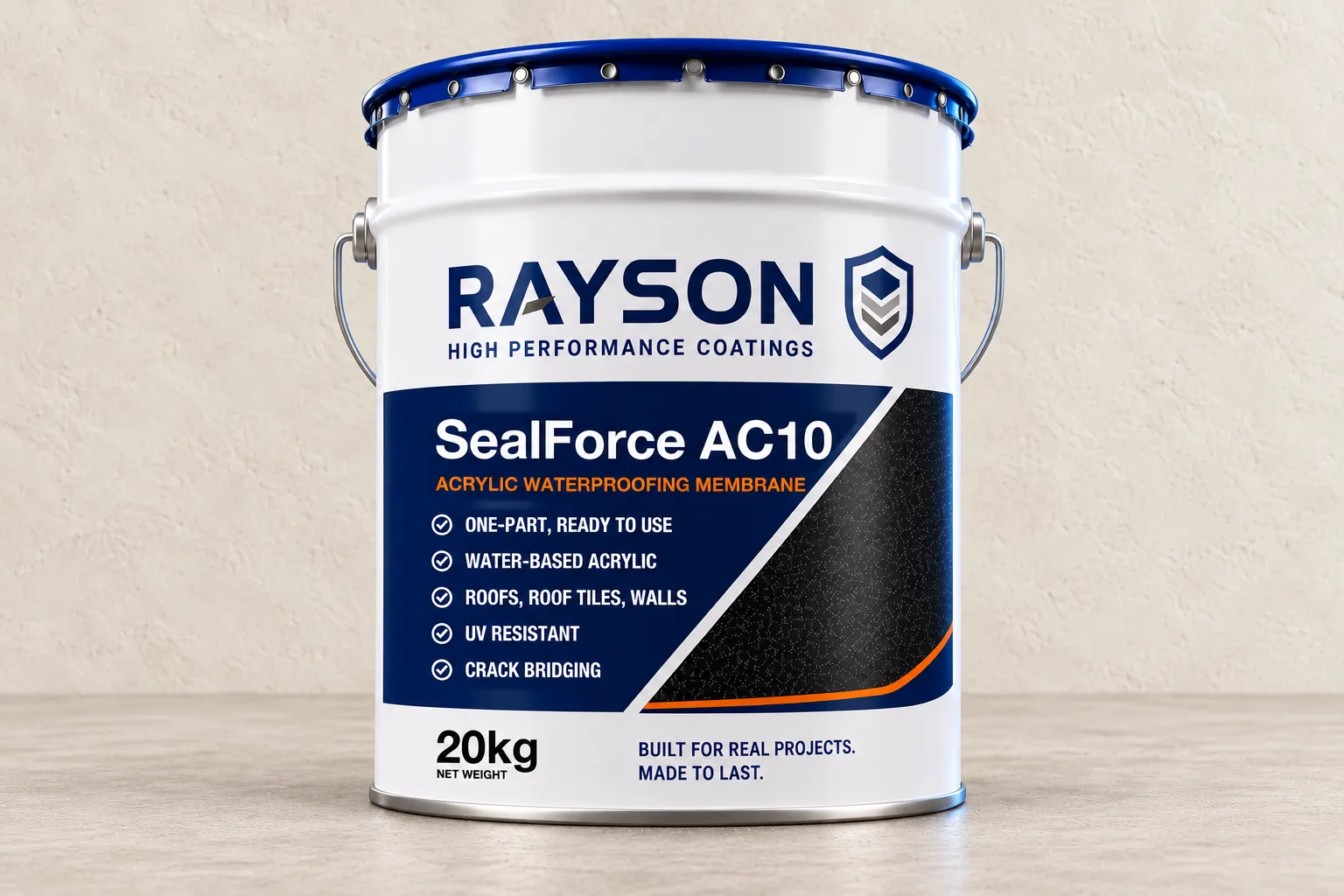
The practical details Rayson SealForce AC10: questions people ask
What is SealForce AC10 used for?
Exposed surfaces that shed water: roofs in new construction and refurbishment, old roof tiles, external walls, and roofs crowded with penetrations, drains and roof lights. It is applied cold from the pail and left exposed. It is not for roofs where water ponds for long periods, or for surfaces people walk on.
How many coats does it need, and how much material?
As a roof coating, two coats at about 0.68 kg/m² each, 0.5 mm wet film per coat. As roof waterproofing, three coats with polyester reinforcing fleece bedded into the first. A 20 kg pail covers about 29 m² per coat, so about 14 m² at two coats or 9 m² at three. Porous or uneven surfaces and wastage take more.
SealForce AC10 or SealForce RC40: which does my roof need?
AC10 is the one-part acrylic for roofs that drain freely and are not walked on: pitched and tiled roofs, external walls, and sound roofs that need an economical recoat. RC40 is the two-component aliphatic polyurea for flat roofs that pond, carry foot traffic or plant, or have to stay elastic from −35 °C to +80 °C. If water stands on the roof after rain, it is an RC40 roof.
Can it be applied over old roof tiles?
Yes, once the roof itself is sound. Loose tiles are fixed, broken or missing ones replaced, and the roof pressure-washed and dried; AC10 then goes on in two coats. It renews and seals weathered tiles and lets them breathe, but it does not repair a leak: a roof that leaks at a broken tile, the ridge, a valley or a flashing needs that repair first.
Can it be used on external walls?
Yes, external walls are one of its uses: the wall is cleaned, cracks and joints are repaired and reinforced, and AC10 is applied in two coats. In an HDB block or a condominium the external wall is common property, so the Town Council or the management corporation arranges the work; in a landed house it is the owner's.
Does it need a primer?
Yes, on concrete, render, brick, stone and tiles: one coat of Rayson SealForce AP05 at about 0.1 to 0.3 kg/m², two on very porous surfaces, left until it has dried clear, about 30 minutes, before the first AC10 coat. Metal is abraded to a bright finish and takes an anti-corrosion metal primer instead, and a sound old coating gets a trial area first.
What weather does the work need?
Dry weather. Each coat has to be protected from rain, damp and condensation until it has dried, with 4 to 8 hours between coats. Apply between +8 °C and +40 °C, at no more than 80% relative humidity, on a substrate at least 3 °C above the dew point and with no more than 6% moisture. In Singapore that means planning the coats around the rain, above all during the Northeast Monsoon from November to January.
Can it take ponding water or foot traffic?
No. It must not be used on roofs where water ponds for long periods, and it is not recommended for direct pedestrian traffic. Correct the falls so the roof drains, or use SealForce RC40, which is walkable and resists ponding water.
What colours does it come in?
White, grey, green, clay brown, brick red, tile brown, red and black, with other colours on request. Applied colours are approximate to the chart, and the colour can shift slightly in direct sunlight without affecting how the membrane performs.
Is SealForce AC10 available to order now?
SealForce AC10 is part of Rayson's upcoming waterproofing release. Send the project details and your required date, and Rayson will confirm supply timing, colours, quantities and, where you need one, an applicator in the Rayson network before you commit.