RAYSONHIGH PERFORMANCE COATINGSMALAYSIA
Guide · Decorative finishes · Bathrooms and floors

Microcement vs tiles: which is better for your floor or bathroom?

Microcement vs tiles for a bathroom, condo or shop in Malaysia: which is better where, over old tiles, waterproofing under both, disadvantages and cost.

We reply within one working day, Monday to Friday.

By Rayson Malaysia (Epovex Coatings Sdn. Bhd.), the maker, from its data sheets. Published 25 October 2026.

Questions people ask

Which is better, microcement or tiles?

Neither, everywhere. Choose microcement for a seamless, mineral look that runs across the floor, the walls and the stairs, for a dry room where the old tiles can stay underneath, and for a bathroom where grout lines are the thing you want rid of. Choose tiles where you want to replace a single damaged piece, where a pattern or texture is the look, and on outdoor terraces and pool surrounds in sun and standing water.

In a bathroom or shower the choice changes nothing underneath: both go over SealForce WB20 after its ponding test. The rest of this guide takes the questions one at a time, and the applicator confirms the base on site and the finish on a sample board.

Is microcement waterproof?

No, and neither are tiles. Microcement is a decorative finish; in a bathroom or shower the waterproofing is the membrane underneath. SealForce WB20 goes on in two coats over concrete, render or screed and passes a ponding test 24 hours after the final coat, before any finish goes on.

That is the same whichever finish you choose. In a condo with a neighbour below, the membrane matters more than the finish, and the floor must fall to the drain so water does not stand.

Can microcement go over my old tiles?

In dry rooms, over firmly bonded tiles, usually yes: the applicator taps every tile, takes out hollow ones, fills the grout lines and primes, so there is no hacking, and far less noise and debris. In a bathroom or shower, no: the membrane comes first, and SealForce WB20 does not go on glazed tiles.

In a wet area, then, the old tiles come up or a new screed bonded with SealForce RW1 goes over them, and the applicator says which before it quotes. New tiles go on the same membrane, so in a wet area the choice is between finishes, not between doing and skipping the waterproofing.

Which is easier to keep clean?

Microcement has no grout lines, which is where dirt and mould usually settle in a tiled bathroom. It needs a mild, pH-neutral cleaner and a sealer renewed as the IFS system advises; harsh acids and bleach wear the sealer first. Glazed tiles tolerate most cleaners, but the grout darkens and in time needs cleaning or regrouting.

Either way, a fan or a window matters as much as the finish: mould grows where water stands and air does not move.

Which is less slippery?

It depends on the finish, not the material. A smooth, sealed microcement and a polished tile are both slippery when wet. For shower floors the applicator chooses a microcement finish with more grip on the sample board; with tiles, choose one rated for wet floors.

Either way the floor falls to the drain so water does not stand, and the falls are corrected in the screed before any finish.

What happens if it cracks or gets damaged?

A cracked tile can be replaced on its own, if a matching tile can still be found. Microcement is one continuous surface: it follows what is underneath, so a crack in the screed or a hollow tile below can show through, and a repair is patched and resealed rather than swapped.

That is why the base is checked first: hollow tiles out, cracks and hollow render repaired, and the build-up confirmed on a sample board. Movement joints in the building stay as joints in either finish.

What are the disadvantages of microcement?

Five, and each is managed rather than removed. It follows what is underneath, so a hollow tile or a moving crack can show through. A repair is patched and resealed, not swapped, and the patch can show. Its sealer wears under harsh cleaners and is renewed as IFS advises. It is a skilled, multi-layer finish, so the applicator matters more than with tiles. And it is quoted as a premium finish: more layers and hand work than a tiled floor of the same size.

None of these is a reason to skip it where the seamless look is the point; they are the reasons the base is checked, the build-up is confirmed on a sample board and the finish is left to a Rayson-authorised applicator.

What decides the cost of microcement?

Four things, quoted per square foot after inspection: what is underneath (sound tiles that stay, hollow tiles that come out, or a new screed), how much runs onto walls and stairs against open floor, the waterproofing in a wet area, and the sample board and sealer the IFS system calls for. Rayson publishes no price list.

In a dry room over sound tiles, skipping the hacking and the new screed changes the comparison with new tiles; in a bathroom both finishes carry the same membrane. Send three photos and the area for a first idea; the quotation follows the inspection. The microcement cost guide goes further.

How long does each take, and how much noise in a condo?

Hacking old tiles is the noisy, dusty part of any bathroom job, and it usually takes the first days. Microcement over sound tiles in dry rooms skips it; in a bathroom the old tiles usually come up for the membrane, whichever finish follows.

Microcement then goes on in thin layers that each cure before the next, with the sealer last, over several working days; tiling waits for the adhesive and grout to set. In a strata building, the applicator plans the working hours, the lift and corridor protection and the renovation permit with the management first.

When are tiles the better choice?

Where you want to replace a single damaged piece, where a patterned or textured tile is the look you want, and on outdoor terraces and pool surrounds, where a microcement build-up must first be checked for sun and standing water. Microcement suits rooms where one seamless, mineral surface across floors, walls and stairs is the point.

Commercial kitchens and wet process floors take neither: they take a PU-cement screed such as PurScreed PC70.
Microcement and tiles, side by side

Microcement and tiles, side by side
Compared onIFS MicroCrete® microcementTiles
SurfaceOne seamless surface, no grout linesTiles with grout joints
Over old tilesIn dry rooms, over firmly bonded tiles, without hackingOld tiles are usually hacked off first
In a showerOver SealForce WB20, after a ponding testOver SealForce WB20, after a ponding test
CleaningA pH-neutral cleaner; the sealer renewedMost cleaners; the grout darkens in time
RepairsPatched and resealedA single tile replaced, if a match can be found
Walls and stairsThe same finish runs onto walls and stairsTiles, with trims at edges and corners

A first guide. The applicator confirms the base and the finish for your room on site, and the microcement on a sample board.

The layers

The two build-ups in a bathroom, layer by layer

Layers, top to bottom: MicroCrete® microcement, trowelled and sealed · IFS partner range; SealForce WB20 membrane in bathrooms and showers; Screed or render, laid to falls

The build-up, top to bottom · diagram, not to scale

  1. MicroCrete® microcement, trowelled and sealed · IFS partner range
  2. SealForce WB20 membrane in bathrooms and showers
  3. Screed or render, laid to falls

Dry rooms: PrimeBond E20 on concrete or screed, or a bonding primer over firmly bonded tiles, in place of the membrane.

Microcement: IFS MicroCrete® trowelled and sealed over SealForce WB20 on a screed laid to falls.
Layers, top to bottom: Tiles, laid after the 24-hour flood test; Tile bed with SealForce RW1; SealForce WB20, two coats, turned up the walls; Screed with SealForce RW1; Floor slab

The build-up, top to bottom · diagram, not to scale

  1. Tiles, laid after the 24-hour flood test
  2. Tile bed with SealForce RW1
  3. SealForce WB20, two coats, turned up the walls
  4. Screed with SealForce RW1
  5. Floor slab
Tiles: bedded with SealForce RW1 over the same SealForce WB20, laid after the 24-hour ponding test.
What to send

Three photos are enough for a first quotation

  1. The room, wide, with the floor and walls in view
  2. The surface close: tiles, screed or plaster, and any hollow-sounding tiles
  3. A look you like, and the building: condo, landed home or shop

Send them on WhatsApp

Who you deal with

  • Rayson makes the materials, writes the specification and warrants the material. It sells the materials direct through Epovex Coatings Sdn. Bhd., quoted per order.
  • The Rayson-authorised applicator for your area an independent company in Johor, Kuala Lumpur and the Klang Valley, or Penang, inspects, quotes per square foot, contracts with you and warrants the workmanship.
  • Rayson is not the installer and is not a party to the installation contract. Two warranties, two companies.
Rayson materials in this guide

Every Rayson layer has a published data sheet

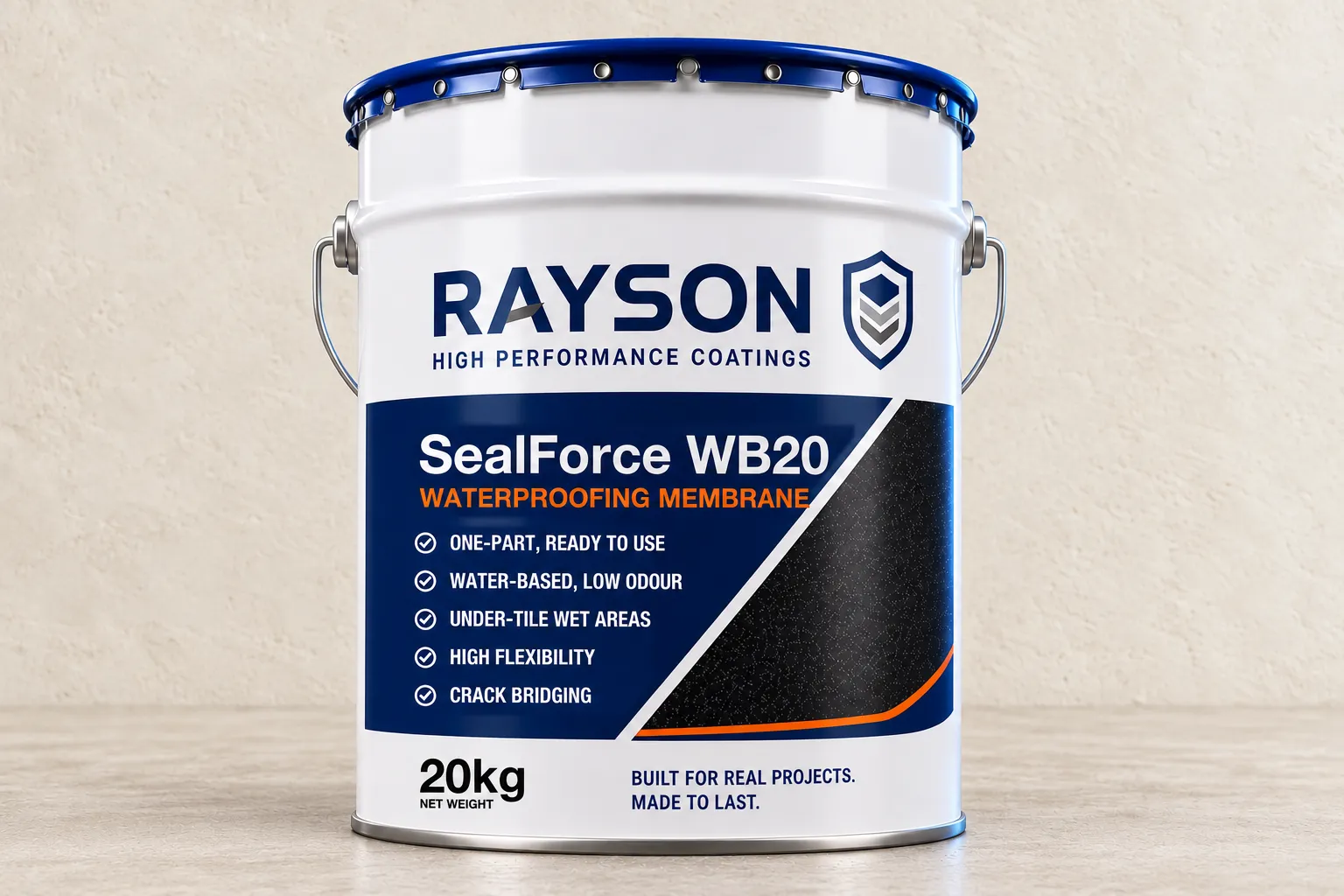
Rayson SealForce WB20 pail

Rayson SealForce WB20

Rayson SealForce WB20 is a one-part, water-based, polyurethane-modified waterproofing membrane for toilets, showers, bathrooms, balconies and other interior wet areas — rolled or brushed on in two coats and concealed beneath the tiles, screed or render.

Specifications →
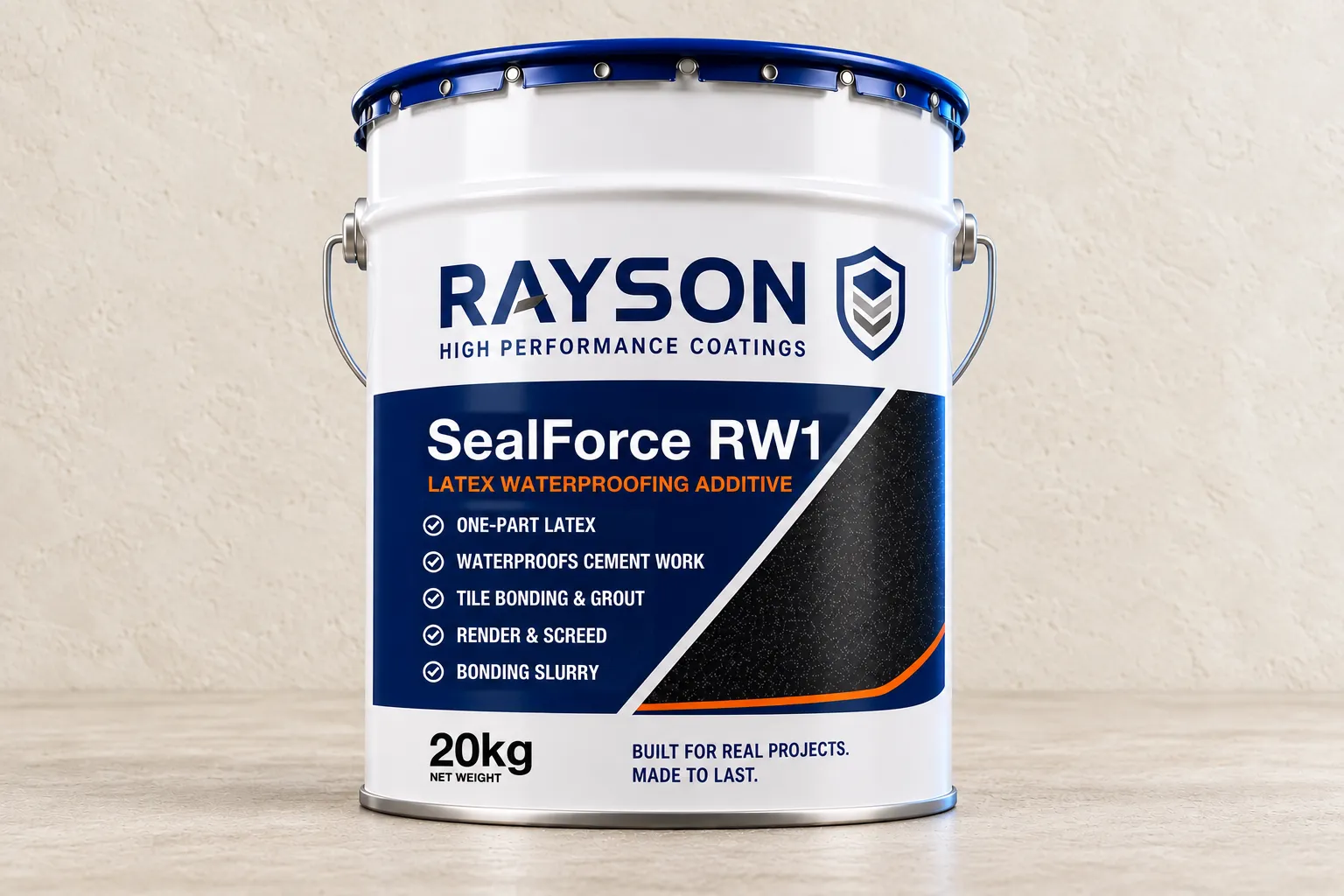
Rayson SealForce RW1 pail

Rayson SealForce RW1

Rayson SealForce RW1 is a one-part latex waterproofing and bonding additive for cement-based work — mixed into renders, screeds, slurry coats, tile adhesives and grout to cut water penetration, strengthen the mortar and improve its bond and flexibility.

Specifications →
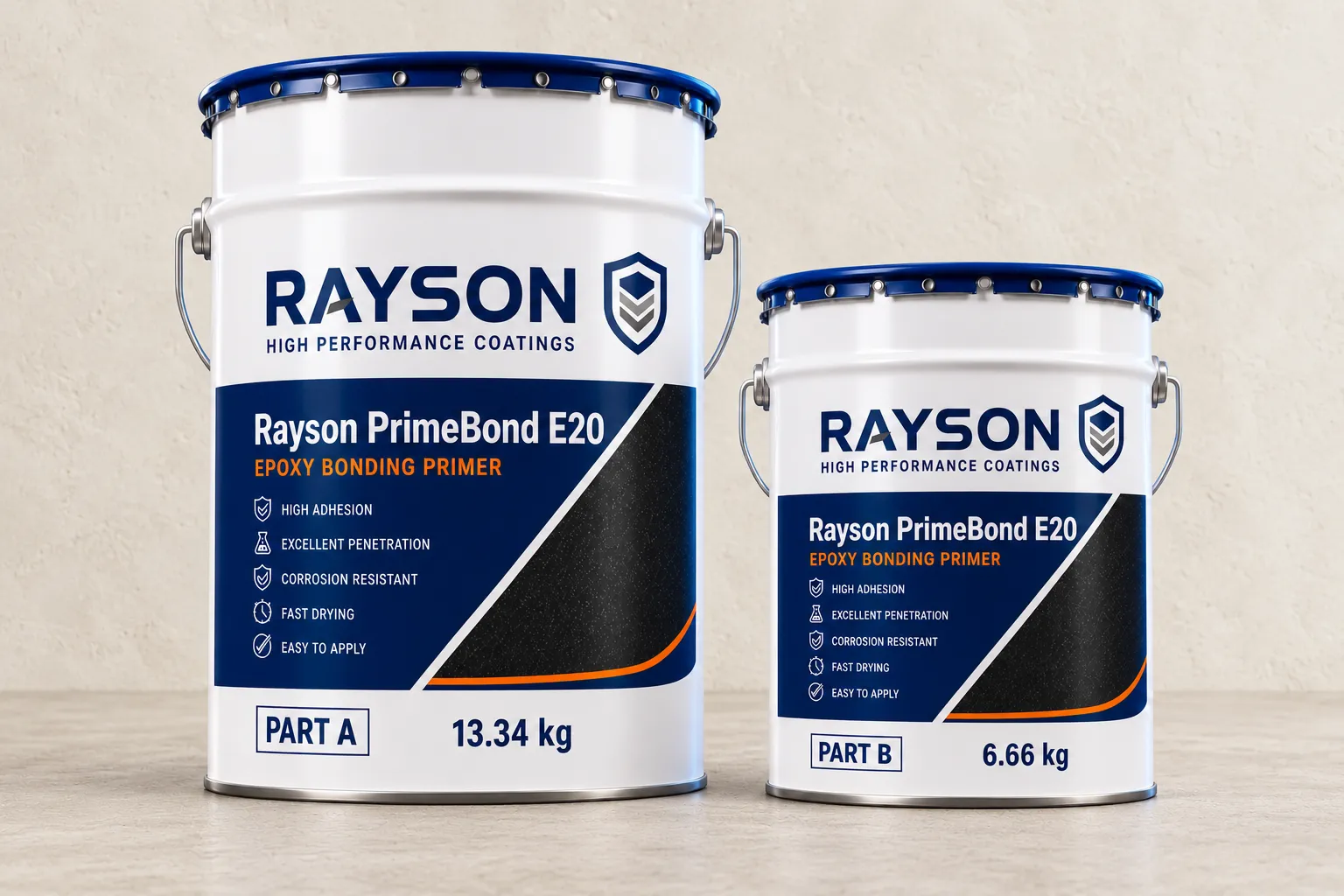
Rayson PrimeBond E20 pail

Rayson PrimeBond E20

Rayson PrimeBond E20 is a two-component, medium-viscosity, solvent-free epoxy bonding primer that anchors resin floor systems to concrete, screed, asphalt and prepared metal — on dry or damp substrates.

Specifications →
Go deeper

The pages for the work itself

Each with the Rayson layers it uses

01 IFS finish · Rayson base Layers: MicroCrete® microcement, trowelled and sealed · IFS partner range; SealForce WB20 membrane in bathrooms and showers; Screed or render, laid to falls

Microcement in KL, Selangor and Penang

Seamless IFS MicroCrete® for condo bathrooms, floors and walls, with Rayson waterproofing under every wet area.

  1. MicroCrete® microcement, trowelled and sealed · IFS partner range
  2. SealForce WB20 membrane in bathrooms and showers
  3. Screed or render, laid to falls

Dry rooms: PrimeBond E20 on concrete or screed, or a bonding primer over firmly bonded tiles, in place of the membrane.

Quoted after inspection
02 Rayson system Layers: New tiles, once the 24-hour ponding test holds; Tile adhesive and grout with SealForce RW1; SealForce WB20, two coats, up the walls and round the trap; Screed repaired and laid to fall to the trap; Floor slab over the unit below

Toilet and bathroom waterproofing in KL and Selangor

Condo and landed-home bathrooms in the Klang Valley re-waterproofed with SealForce WB20 under the tiles, ponding-tested before anything goes back.

  1. New tiles, once the 24-hour ponding test holds
  2. Tile adhesive and grout with SealForce RW1
  3. SealForce WB20, two coats, up the walls and round the trap
  4. Screed repaired and laid to fall to the trap
  5. Floor slab over the unit below

Seamless instead of tiles: IFS MicroCrete® over the same ponding-tested WB20, confirmed on a sample first.

Quoted after inspection
03 Rayson system Layers: Tiles, laid after the 24-hour flood test; Tile bed with SealForce RW1; SealForce WB20, two coats, turned up the walls; Screed with SealForce RW1; Floor slab

Toilet and bathroom waterproofing

The membrane under the tiles, done once and flood-tested before the tiler starts.

  1. Tiles, laid after the 24-hour flood test
  2. Tile bed with SealForce RW1
  3. SealForce WB20, two coats, turned up the walls
  4. Screed with SealForce RW1
  5. Floor slab
Quoted after inspection
More guides

Other decisions before you buy a floor

  • What decides the cost of epoxy flooring: The six things that set the price per square foot, what a fair quotation lists, and the questions to ask before you sign.
  • Epoxy vs tiles: For homes, porches, garages, kitchens and shops: which is better where, coating over tiles, slip, sunlight, repairs, disadvantages and cost.
  • Epoxy over tiles: Whether an epoxy floor can go over existing tiles, how an applicator prepares and primes them, what it costs against hacking, and when the tiles must come up.
  • What decides the cost of microcement: The six things that set the price of microcement per square foot, what a fair quotation lists, and why a bathroom costs more than a dry room.

All guides

The practical details

Questions people ask

Is microcement cheaper than tiles?

Usually not per square foot: it is a hand-applied, multi-layer finish, so it is quoted as a premium finish. In a dry room over sound tiles it avoids the hacking and the new screed that new tiles need, which narrows the gap. It is quoted per square foot after inspection; Rayson publishes no price list.

Is microcement available in Malaysia?

Yes. IFS MicroCrete® microcement is installed by independent, Rayson-authorised applicators in Kuala Lumpur and the Klang Valley, Penang and Johor, over Rayson primers and the SealForce WB20 membrane in wet areas, after a sample board.

Does microcement crack?

It can, if the base moves or is hollow, because it follows what is underneath. Hollow tiles and cracked render are dealt with first, and the build-up is confirmed on a sample board before your room.

Can microcement go in a shower?

Yes, over SealForce WB20 that has passed its ponding test, with the floor falling to the drain and a finish with more grip chosen on the sample board. The membrane does the waterproofing; the microcement is the finish.

Who installs microcement, and who warrants it?

An independent, Rayson-authorised applicator in your area: Kuala Lumpur and the Klang Valley, Penang, or Johor. Rayson warrants its layers as their maker, IFS’s terms cover the MicroCrete® finish, and the applicator warrants the workmanship.

Is MicroCrete® a Rayson product?

No. MicroCrete® belongs to Industrial Floor & Systems Pte. Ltd (IFS), a partner, and carries IFS’s own terms; the waterproofing and primers under it are Rayson materials with published data sheets.

Start a conversation / ↗

Send the job, or ask for materials

Tell us what the surface is, where it is and what it has to withstand. Rayson replies with a system recommendation; for installation, the applicator for your area in Johor, Kuala Lumpur or Penang is introduced to quote the job.

Malaysia launch: 1 March 2027. Enquiries are welcome now; supply, site assessment and installation timing are confirmed for each project.

Thank you. Your enquiry has been received and we reply within one working day, Monday to Friday.

WhatsApp
WhatsApp three photos