Heavy-duty F&B production floor
- Mechanically prepare the slab, repair defects and detail drains and coves
- Apply Rayson PurScreed PC70 as a self-smoothing screed at 1.5–3 mm by steel trowel
Rayson PurScreed PC70 is a four-part, water-based polyurethane-cement self-smoothing screed installed at 1.5–3 mm for medium to heavy-duty industrial floors with high chemical resistance.
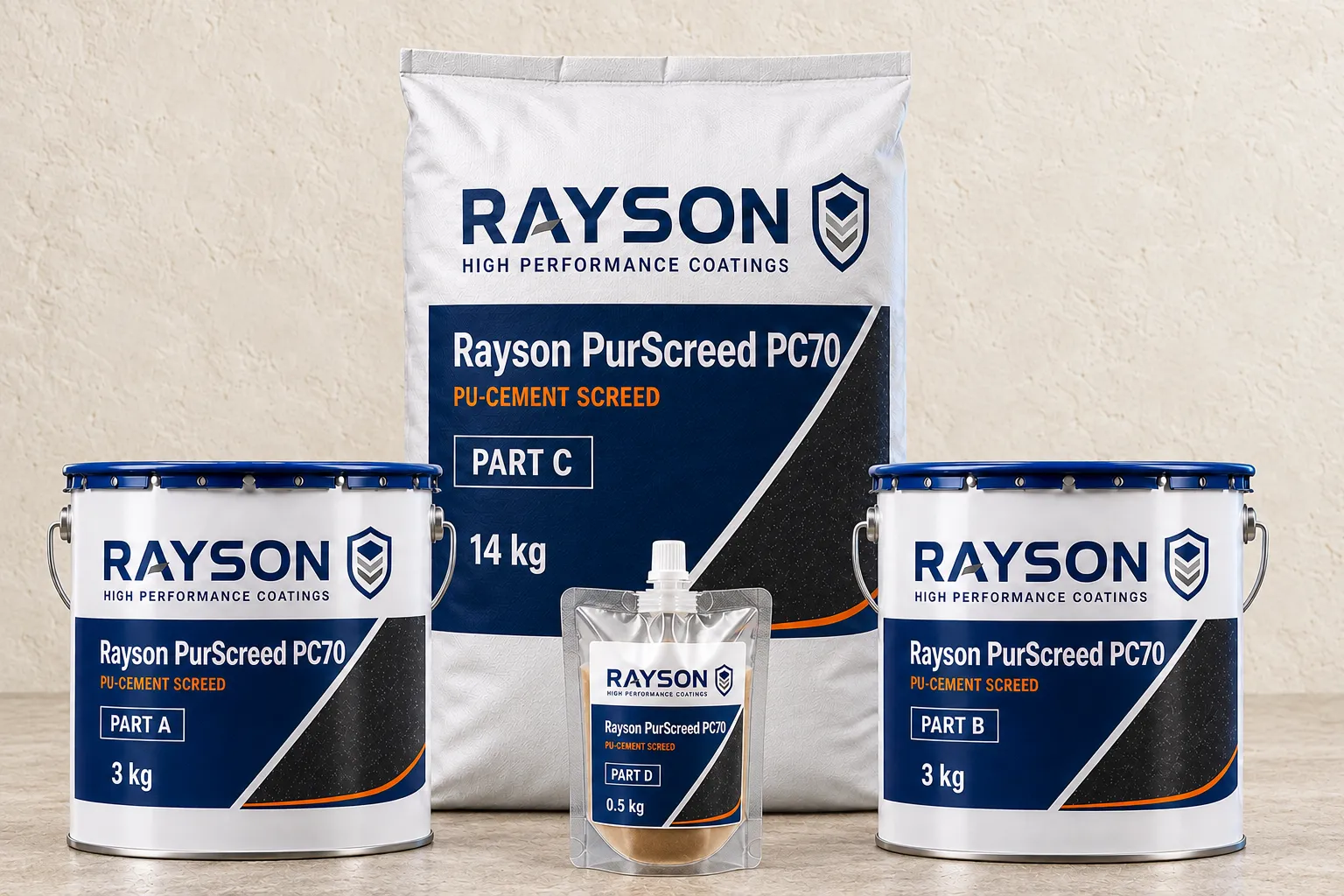
PurScreed PC70 combines four pre-weighed parts into a coloured, self-smoothing polyurethane-cement hybrid screed. Installed at 1.5–3 mm by steel trowel, it produces a floor with tough mechanical and chemical resistance for rough, high-traffic industrial service.
Adhesion to mechanically prepared concrete is exceptional — in bond testing the concrete fails before the screed does. The four-part system is flexible in use: it can serve as primer, base coat or wear coat within heavy-duty build-ups, and it handles highly absorbent substrates.
PU-cement screeds are the default choice where epoxies run out of headroom — the production, wash-down and processing floors of food, beverage and chemical facilities. Match the grade and thickness to your loading and exposure with our technical team.
Supplied by Epovex Coatings Sdn. Bhd., Company No. 202601042128 (1704223-A). The Malaysia launch is scheduled for 1 March 2027; confirm availability and lead time for your project. Installation through an authorised applicator in Johor, Kuala Lumpur or Penang introduced by Rayson, who quotes and warrants the workmanship, or by your own crew with Rayson’s application guidance.
Send an enquiry| Specification | Data sheet value |
|---|---|
| Coverage | 1.8 kg/m² per mm of thickness (varies with substrate condition) |
| Mixing | Combine Parts A, B, C and D in the sequence stated in the current PurScreed PC70 method statement; mix mechanically until uniform; pot life 15–20 minutes at 30 °C |
| Drying and curing | Final cure 7 days |
| Pack sizes | Part A 3 kg / Part B 3 kg / Part C 14 kg / Part D 0.5 kg per set |
Rayson-authorised applicators in Johor, Kuala Lumpur and Penang install Rayson PurScreed PC70 on these jobs and in these industries; its layer is marked in each build-up. Each page shows how the work runs, what to send for a quotation and what decides the price.
Jobs in Johor
Forklift aisles, production floors and loading bays in Johor’s industrial parks, specified by the maker.
Storage halls: FloorGuard R50 roller coat. Hot washdown or spillage: PurScreed PC70.
Quoted after inspectionJobs in Kuala Lumpur and Selangor
Kuala Lumpur and Selangor ↗Factory, warehouse, car park, showroom and home floors in the Klang Valley, with the Rayson system named for the traffic.
Storage halls, workshops and garages: FloorGuard R50, two coats. Hot washdown: PurScreed PC70. Showrooms: R50 under UraForce WB58.
Quoted after inspectionBy industry, across Malaysia
Industries we cover ↗Hot washdown, wet process and dry store floors for food and beverage plants, with coves and drains detailed.
Dry stores and packing: FloorGuard R50 or LevelShield SL120 over PrimeBond E20. Walls: UraForce WB58.
Quoted after inspectionForklift aisles, racking zones and loading bays in warehouses and distribution centres, in self-levelling or roller-applied epoxy.
Racking and storage zones: FloorGuard R50 roller coats. Heavy traffic with spillage: PurScreed PC70.
Quoted after inspectionCooking lines, dishwash and prep areas in central, hotel and restaurant kitchens: PU-cement where it is hot, epoxy where it is dry.
Cold prep, stores and corridors: FloorGuard R50 broadcast with aggregate, over PrimeBond E20.
Quoted after inspectionProduction rooms, clean rooms, device assembly, washdown rooms and stores in pharmaceutical and medical device plants, with smooth, cleanable floors and walls.
Walls: UraForce WB58. ESD assembly: StaticGuard CX90. Washdown rooms: PurScreed PC70.
Quoted after inspectionESD areas, production halls, wet and chemical rooms, warehouses and car parks in electronics and semiconductor plants, zone by zone.
Outside the ESD programme: LevelShield SL120. Wet and chemical rooms: PurScreed PC70. Car parks: FloorGuard R50 broadcast system.
Quoted after inspectionCorridors, service areas, kitchens, laundries, wet rooms, ramps and car parks in hospitals, clinics and care homes, laid in occupied buildings.
Corridors and service areas: LevelShield SL120 or FloorGuard R50. Kitchens and laundries: PurScreed PC70. Walls: UraForce WB58.
Quoted after inspectionClassrooms, corridors, halls, walkways, playgrounds, toilets, canteens and roofs in schools and kindergartens, done in the school holidays.
Walkways, ramps and playgrounds: GripSafe AP12. Toilets: SealForce WB20 under the tiles.
Quoted after inspectionWhen the exposure outruns epoxy — aggressive chemical spill zones, hot wet processing and heavy industrial traffic. For drier, lighter duties an epoxy system like LevelShield SL120 is usually more economical.
Between 1.5 and 3 mm as a self-smoothing screed, selected against loading. Heavier mechanical duty sits at the top of that range — our technical team will match thickness to your traffic.
PU-cement chemistry is the industry answer for thermally aggressive wash-down zones. Verify your specific wash-down regime and temperature limits with our team.
Light grey and green as standard; other colours are available on request with lead time.
The resin, hardener and powder must combine in order and mix fully — shortcuts leave unmixed powder that weakens the screed. Allow 3–4 minutes of mixing after the powder bag is empty.
In hygiene-critical areas, yes — coved details close the floor-wall junction against water and bacteria. Coving is detailed as part of the floor system design.
Tell us what the surface is, where it is and what it has to withstand. Rayson replies with a system recommendation; for installation, the applicator for your area in Johor, Kuala Lumpur or Penang is introduced to quote the job.
Malaysia launch: 1 March 2027. Enquiries are welcome now; supply, site assessment and installation timing are confirmed for each project.